

By BAI Fan
Once the investors’ darling, franchised express delivery outlets have suddenly become "hot potatoes."
A large number of express delivery franchises are up for sale on secondhand marketplaces like Xianyu, with prices ranging from hundreds of thousands of yuan to millions. However, while there are many offers, few are willing to buy.
It’s a big change. The express delivery business is now growing slowly, if at all, with limited potential for profit.
Left in the lurch
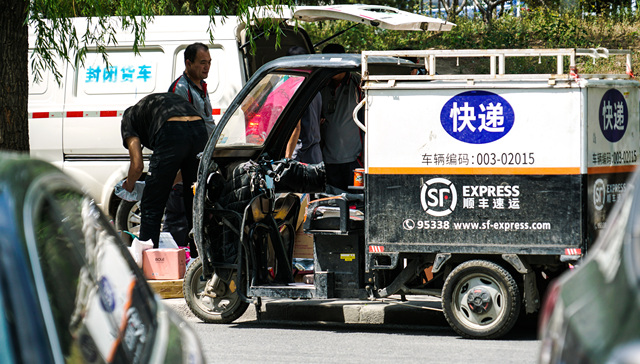
Heavy investment naturally resulted in overcapacity. After three decades of "golden age", the express delivery party is well and truly over and has descended into a free-for-all of mergers, transfers and closures. Franchise obligations and penalties for underperformance have grown and many disputes between outlets and corporate headquarters are heading for the courts.
One ZTO Express outlet is looking for a transfer fee of 5.5 million yuan (US$750,000). More than 22,000 packages are processed at the outlet each day.
The franchise system has evolved to include different levels and a variety of fees.
Primary outlets require the heaviest investment. Secondary outlets are branches of primary outlets under contract. Even smaller operators are limited to a few specific neighborhoods.
Outlets that are doing well have high transfer prices. Those doing badly… no one wants to buy them. The situation is such that some outlet owners have considered giving them away.
Other failing outlets are being forced out by industry mergers. In autumn 2021, J&T acquired Best's domestic express delivery business. In May, SF Express sold its subsidiary Fengwang, to J&T Express, leaving some franchisees in the lurch. If Fengwang undergoes further integration, the two brands, Fengwang and J&T, will become one, resulting in reduced assets and halved brand value.
Rags-to-riches and back again
The industry has automated to increase capacity and well-run express outlets have expanded, but investment in each outlet is often millions of yuan. Some franchises are already relying on loans to sustain them.
One rags-to-riches and back-again franchisee told Jiemian News that he was once a deliveryman but bought a contacted zone in Shenzhen with a deposit of only 20,000 yuan. In 2011, he invested over 500,000 yuan to relocate, and in 2012, he become a primary-level franchisee of YTO Express, continuing to expand and invest.
But the good times didn't last long. In 2014, competition intensified, prices feel and profits evaporated. By 2016, he was losing money. In 2021, he sold his outlet, which had a capital investment of tens of millions, for 1.15 million yuan. The sale included fixed assets such as a fully automated sorting facility and the operating rights of YTO Express.
No evidence of ‘unreasonable’ fees
High costs and decreasing profits have intensified the conflict between outlets and headquarters.
In 2021, CHENG Xiao filed a lawsuit against YTO Express, demanding the return of various unreasonable deductions. In the complaint, Cheng stated that his company was a contracted merchant under YTO Express' franchise agreement. However, since the signing of the agreement in October 2018, YTO Express unilaterally increased or changed fees resulting in a doubling of operating costs and losses of nearly 13 million yuan. Cheng lost the case.
The court ruled that Cheng had not provided sufficient evidence of “unreasonable” fees and had not raised objections at the time.
Cheng is not the only franchisee who has sued headquarters. But the vast majority lose, and the main reason is incomplete agreements between the parties. In operating rights agreements, various fees are not specified and are marked as subject to circumstances.
In the past few years, express delivery companies have increased with a forward-looking perspective considering demand for the next four or five years, leading to excess capacity, and intensifying competition.
The franchising system was certainly a swift way of setting up nationwide networks. The number of outlets reached 231,000 in 2022, a lot more than the 47,000 outlets in 2007. However, issues arising from the density of outlets and increased fines have become more prominent as the market clears.
Operating with outdated strategies
ZHAO Xiaomin, an express logistics expert and CEO of Guanshuo Capital, said that in an effort to maximize the use of franchised outlets to address cash flow issues, delivery companies now have far too many outlets.
"In the next three years, there will be a period of intense fluctuation in the delivery market, with a high probability of closures. And not just in one or two companies, but across all franchising brands," said Zhao. The risks have increased, so even a slight misstep can result in a loss for outlets and investment has become prohibitive.
Zhao pointed out that many franchisees are operating with outdated strategies, which will inevitably lead to turbulence and complicates investment decisions.
As the market falls short of expectations, reducing fees – an instinctive reaction to troubled times - breeds price wars, increasing pressure on outlets. Although the parent companies may reduce delivery fees, the outlets often cannot afford to and are left carrying losses.
Valuable experience from initiatives
Managers complain that the assessments conducted by companies are unreasonable. With business volumes already being met, targets are raised, resulting in a failed assessment and financial penalties. The situation is strained, to say the least.
On June 10, Yunda held a meeting of 200 franchisees in Yiwu where the company committed to improving efficiency and service levels through digitalization. YTO has positioned "digitization and standardization of branch offices" as a top priority.
In finance, human resources and customer service, YTO launched a digital system to help branch offices have a better understanding of their own operations. Currently, over 85 percent of YTO's branch offices are using the system.
Some franchisees have gained valuable experience from these initiatives. Publicly available data shows that a franchise company in Zhejiang, which had been losing money for over ten years rose from the bottom to the top of the province after using the financial system for three months.