

By LU Keyan
In the past five months, CHEN Hua has sold one car. Only one. From one perspective, this is no big deal. How many cars did you sell? On the other, Chen has spent all of his career selling cars and considers himself a veteran car salesman, and this is decidedly not what he signed up for when threw in his lot with Huawei two years ago.
It all stems from the car with at least four names, none of which appear to be its real name.
AITO - Adding intelligence to cars
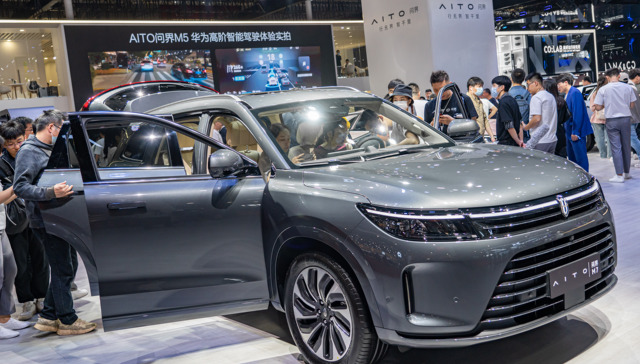
The first name is Seres: What exactly does Seres make? Then there is AITO – a rather confusing jumble of capital letters. Apparently, this is an attempt to coin a neologism that we are told means “adding intelligence to auto” but somehow fails to be an initialism, acronym, or abbreviation. Or grammatical. Maybe add a little bit more intelligence?
It leaves you wondering why a company like Huawei has to deny making “auto,” and why it’s always the English language that gets mangled. Why not try some Danish or Arabic in future “brain” storming sessions?
Then we have Wenjie, the name of the model that Seres claims to have jointly developed with the US-sanctioned smartphone maker, and something that Huawei insists does not mean a thing. Huawei does not make auto (sic) but merely supplies a few bespoke gizmos that might be said to “add intelligence” to auto.
The Seres AITO Wenjie certainly exists and a goodly few thousand are even on the roads. But when Huawei first approached the “little-known car company,” Seres was nothing of the sort.
Only 4,992,000 short of target
A US subsidiary of Seres Group (formerly Chongqing Sokon Industry Group), SF Motors Inc (Seres), was founded in Santa Clara, California in 2016. While describing itself as a carmaker, no vehicles were made or sold until 2019. And that was the first SUV made by Seres, the SF5.
In its debut year without Huawei, Seres only managed to sell about 300 units a month. After the Spring Festival of 2021, Huawei announced its cooperation with Seres, and to "add intelligence" to SF5.
Huawei received more than 300 SF5 orders in three days. YU Chengdong, CEO of Huawei’s automobile business, predicted that he would sell 5 million in a year. In fact, only 8,000 of the uninspiring puddle jumper were shipped in 2021, and a heartbreaking 50 in the first half of 2022.
Everyone wants to be part of something
Huawei promised dealers high commissions. But beyond money, there was also the excitement to be part of something great from day one.
A total of 75,000 Wenjie were sold in 2022, and that is a record for an EV in the first year of release, but EV records are being set all the time. Thereafter, things turned quickly south. Granted, no one has had it easy this year as demand slacked off and a price war was staged across the dashboard, from EVs to ICEs.
In May, around 5,600 AITO Wenjie were delivered, 1,500 more than in April.
But the thousands of sellers will tell you things are more complicated than the simple math of supply and demand.
A very muddled sales strategy
AITO Wenjie is sold in three different types of stores – Huawei flagships, of which there are not many, franchised “experience centers,” similar to Apple Stores but varying in sizes and services, and Seres dealerships. The sheer number of sellers, their proximity to one another, and the different service standards have led to chaotic pricing and an inconsistent customer experience.
Franchisees find it hard to compete with dealerships, which have more leeway in offering discounts, financing and warranties.
“We have no chance against them,” a franchisee says. In his city, 80 percent of purchases are made at dealerships, but that’s still not many.
Even among franchisees, offers can be thousands, sometimes tens of thousands of yuan, apart. That’s despite the fact that Huawei forbids unauthorized discounts. Franchisees need to hit sales targets to keep their licenses, a far-from-easy task. When cars don’t sell, workarounds have to be found, even at the risk of fines or losing your license.
Living off past glories
Huawei exerted a tight grip on phone prices and perhaps feels it can do the same in the car market. The team in charge of distribution, consisting largely of executives from the smartphone business, doesn’t know how to adjust prices or by how much, says a company insider. Nor has it found an incentive mechanism to get the thousands of franchisees to move in sync.
The root cause of the problem, says a Huawei manager, is that franchisees don’t make money.
Although Huawei promised 19,000 yuan of commission for each car sold, a sizable amount given the industry standard, in reality, franchisees are paid less due to falling car prices.
Another franchisee says he gets 15,000 yuan for each car sold, not enough to cover costs. He sells only one Wenjie a month but pays his workers 50,000 yuan at least. Huawei mandates that each franchisee have at least six salespeople, two cars for display, and two cars for test drives. His store would be deep in the red if it were not for revenue from phones and gadgets.
“I thought cars would make my store more profitable. They turned out to be a burden,” he said.
‘Not be good at selling cars’
In an earlier interview with Jiemian News, Yu Chengdong, CEO of Huawei’s automobile business, admits he was “too naive.”
“Good phone salespeople may not be good at selling cars,” he said.
This year, Huawei will refrain from expanding too quickly and closing unprofitable stores, focusing on the professionalism of the sales force and customer experience.
Underperformers have reportedly been told to stop selling cars or close altogether. Chen Hua himself knows four franchisees in Guangzhou who have closed voluntarily.
Only one car per day
AITO Wenjie is, in fact, not the first car Huawei made with Seres.
Since its extremely profitable smartphone business was asphyxiated by US sanctions, the company has been desperately seeking alternative sources of revenue. Probably wary of the many pitfalls of car making and not wanting to be seen as just another Tesla wannabe, the company stresses that it is not making cars, but doing something no one has done before. It will work with numerous car companies, providing design advice, parts, software and distribution channels. The fault, perhaps, is in the distribution channels, not the Seres factory.
In the spring of 2021, Huawei and Seres unveiled SF5 at Shanghai Auto. Yu Chengdong expected it to be in the stores within three months, a huge rush even for established car makers.
Representatives were “sent” to other car companies to learn how to receive customers and take them on test drives. A presale website was hastily put together, with unfinished backend functions manually performed with pen and paper. The retail venues had to be refitted with display platforms and charging stations, which entailed renegotiating leases.
SF5 sold a disappointing 8,196 units in 2021, which Yu blamed on Seres. This prompted Huawei to be more involved in the next model, the AITO Wenjie. This time, Yu set what must have seemed like a more realistic of selling 300,000 cars a year.
In a leaked video of an internal meeting, he half-jokingly asked his team “Huawei has thousands of stores across the country. We can ask each one of them to sell one car a day, can’t we?”
No one laughed.
Dozens of other options
Hence the rush to sign up franchisees. Some employees observed that the bar for entry was significantly lowered and that in some cases, even mom-and-pop phone shops were approved. Last year’s results were encouraging but in the first months of this year, fewer than 22,000 cars rolled off the lots, or out of the phone shops. This means most stores struggle to sell one a month.
Yu continues to attribute the underperformance to Seres’ slow production and promises improvements once capacity catches up. But both employees and franchisees are doubtful given the state of the market.
“I think the AITO Wenjie itself is not a bad car. But a car is a big-ticket item and most people don’t make decisions based on how ‘smart’ it is. Plus, there are only a handful of big phone brands. In the car market, if a buyer doesn’t like Huawei, there are dozens of other options,” a franchisee says.
It’s not just buyers that Huawei needs to compete for.
“Extremely loyal franchisees might be willing to lose money for one year, or two. Anything longer, no one will stay,” another franchisee says.
A lot of thinking to do
Yu promises to make the car-making business profitable by 2025 and he has been busy looking for new partners including Chery, BAIC, and JAC.
But 2023 has proved that design and manufacturing are only a few pixels in a very big picture. With retailers, unintended consequences can undermine good intentions
Yu has a lot of thinking to do. In an interview with the state broadcaster CCTV, Yu says sometimes at night he tries to walk off the pressure till dawn. A new dawn cannot come soon enough for Huawei.