

By WANG Gongyi, WU Yangyu
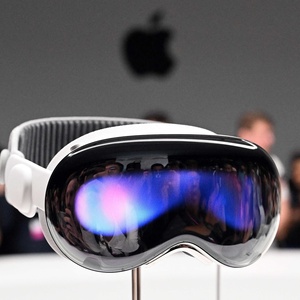
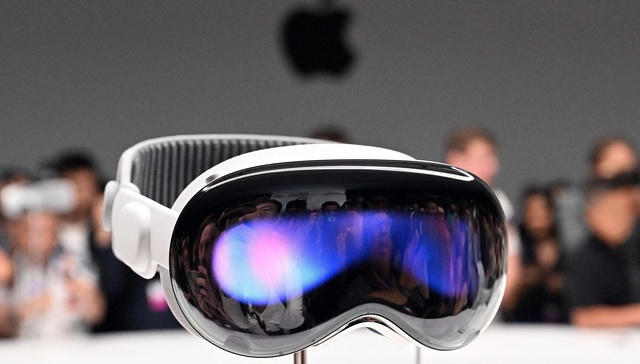
Apple unveiled its long-awaited mixed reality headset called Apple Vision Pro on Monday during its Worldwide Developers Conference.
Users can interact with “apps and experiences” in an augmented reality (AR) version of their own surroundings or in a fully immersive virtual reality (VR) space.
Disney ready
The headset runs on its own OS, much faster than iOS. The user interface is similar to that of iOS but instead of being displayed on a screen, it floats in front of the user.
The most futuristic feature is that it is completely controller-free. You browse, click, scroll and type with your eyes, hands and voice.
It can be synchronized to the iPhone, Macbook, and iPad. Facetime conferences with other Apple users are enhanced with spatial audio. For entertainment, there are over 100 games as well as content on Disney+. The headset adjusts lighting and audio automatically to the surrounding environment. There is a button for taking 3D videos and photos.
Alone in your head
Apple stressed that the headset will not make users feel isolated. Users will be able to see people approaching them more prominently than the displayed content. People around the user can see their eyes instead of just a glass screen.
In terms of hardware, the screen is extremely pixel-dense. It has 64 pixels in roughly the space as a standard iPhone pixel. There are magnetic glasses that clip onto the screen for nearsighted users.
The headset is equipped with five sensors, six microphones and twelve cameras, all powered by Apple’s M2 chip. There’s also a new R1 chip, which the company claims can process the sensor data within 12 milliseconds – eight times faster than the blink of an eye. This reduces delays in processing and alleviates the motion sickness often reported by VR goggles users.
One-size-fits-all
The battery supports up to two hours of use. Charging can be done through a portable battery pack or a cable. The headset is cloth-lined and modular to fit different face shapes and head sizes. To reduce weight, the lens is made from laminated glass and the frame from aluminum alloy.
The device will start at US$3,499 (25,000 yuan) and launch early next year.
Apple also announced new features in iOS 17, the latest version of its operating system. Highlights include Live Voicemail, which transcribes voicemails in real time so the user can decide whether to pick up; Check In, which allows users to inform families and friends that they have arrived home safely; and an enhanced AirDrop function that allows users to exchange contact information by tapping their phones. In terms of new apps, there’s a new journaling app and Standby, which serves as a nightstand.
Everyone at the party
Airpod noise canceling will adapt automatically to the sounds around, and watchOS has new fitness and mental health apps.
Apple also released a new 15-inch MacBook Air. There’s also a new chip in the M2 family called M2 Ultra. It supposedly delivers huge performance increases to the Mac.
Apple shares jumped 17 percent on the release.