

By ZHOU Shuqi
Chinese automaker BYD recorded a net profit of 4.13 billion yuan (US$597 million) in Q1 this year, exceeding the net profit of 3 billion yuan for the entire year of 2021. Q1 revenue grew 79.8 percent year-on-year.
The performance is all down to sales of EVs. In Q1, the company sold half a million cars, twice as many as last year.
BYD's overall gross profit margin in Q1 was 17.8 percent, down from 19 percent in Q4 last year. In fact, key indicators such as revenue, net profit attributable to shareholders, and non-recurring net profit all declined quarter-on-quarter, with net profit attributable to shareholders by 43.5 percent.
Overall, the automobile industry's profit in Q1 declined. According to data from the National Bureau of Statistics, from January to March, the total profit of the automobile manufacturing industry was 81.9 billion yuan, a year-on-year decrease of 24.2 percent.
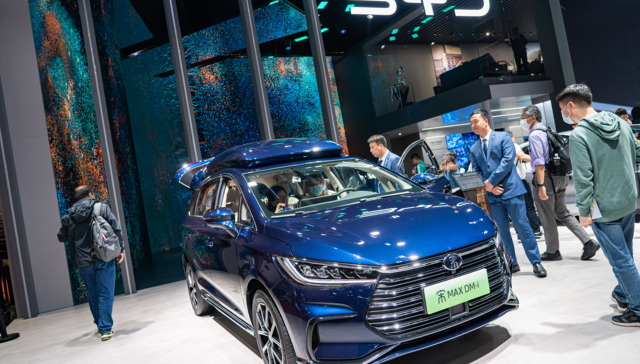
The withdrawal of national subsidies impacted BYD's profitability to some extent. In November BYD raised the prices of some models by up to 6,000 yuan. Soon after, the price war began and BYD lowered the prices of some models by as much as 62,000 yuan, including one which had been raised only a few weeks before.
The good news for BYD with a very large battery division is that the price of battery-grade lithium carbonate continues to decline, from a high of nearly 600,000 yuan/ton to below 200,000 yuan/ton, which will create a larger profit margin for the company.
ZHU Jiangming, chairman of EV maker Leap Motor, has said that for every 100,000 yuan/ton drop in lithium carbonate price, the cost of each kWh can be reduced by 50 yuan. Taking a 70 kWh battery pack as an example, it can save 3,500 yuan.
While BYD dominates the mainstream market, it is launching an offensive in the high-end with Denza and Yangwang. The Denza is key to the new luxury market at 500,000 yuan, and the Yangwang is testing the million-level EV market. BYD also plans to launch a professional and personalized brand, positioned between the Yangwang and Denza, with an overall price comparable to first-tier luxury brands.
Multiple brands increase R&D costs. In Q1, R&D expenses reached 6.2 billion yuan, a rise of 164 percent year-on-year. This is equivalent to Geely Group's full-year research and development expenses in 2022.
BYD Chairman WANG Chuanfu aims to become China's largest car manufacturer by the end of this year with sales of at least 3 million vehicles, but hoping for 3.6 million. If this target is achieved, BYD will be a top ten global car manufacturer.