

By PAN Tao
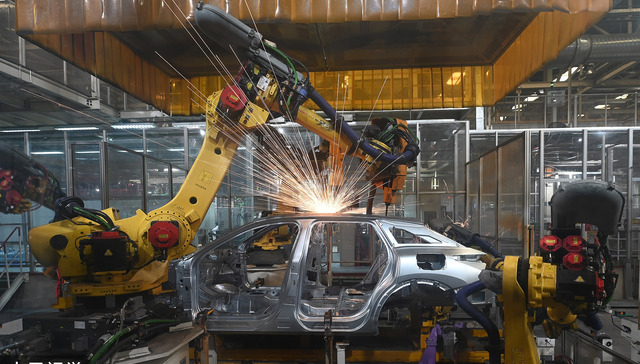
For car makers, capacity is an indicator of power, or so it was until recently. Now it has become a burden. China’s auto industry can make 40 million cars a year, but only made about 20 million last year. That will fall even further when even more capacity (10 million units) comes on line, if not going into operation.
Over-investment and production delays play a role. In Jiangsu Province, which has invested over 100 billion yuan in EV manufacturing, only 33 percent of the built capacity was used last year, down from 2016’s 78 percent.
Large ICE car makers, although not suffering as much from excess capacity, have seen a decline in utilization in the past three years – Dongfeng from 87 percent to 79 percent, GAC from 77 percent to 73 percent, and SAIC from 87 percent to 74 percent. Gross margins of all three have either been falling or hovering below the industry average.
LI Jie, who works at a SAIC factory, said his company puts workers on furlough during low seasons to save costs. Year-round utilization is about 50 percent.
Experts generally agree that utilization between 70 percent and 80 percent is still reasonable. “Demand is seasonal. Anything above 90 percent means the factory will have to frontload peak season production to low seasons and wait for six months to sell the cars,” said CUI Dongshu, director of the China Passenger Car Association.
Since 2017, the ICE car market has shrunk 25 percent to 17.8 million units a year while EV sales increased more than fourfold to over 3.5 million units. Although almost all traditional car makers are trying to go electric, the transition from ICE to EV is not straightforward.
“Most ICE makers prefer to adapt existing plants to EV so that their previous investments don’t all go to waste,” said ZENG Zhilin, manager at data platform LMC Automotive. It takes about two years and an enormous amount of money to build an EV factory from scratch and not much less time to bring production up to speed. Converting an already up-and-running factory, in contrast, takes three to six months.
Given the underutilization and the massive costs of shutting an entire plant down, most companies convert only part of a plant at a time. Li Jie’s factory, for example, started the work late last year and finished only recently.
Some production processes are more challenging to adapt to EV than others. Assembly – the final step where various parts are attached to the body – requires the most rewiring because of the structural differences between ICE and EV.
The real challenge, however, is to adapt internal processes and management style to EV production and sales, and to balance conflicting interests during the transition. Layoffs and asset write-offs cost dearly, both in financial and political terms. Before Volkswagon’s pro-EV CEO Herbert Diess was forced to resign this summer, he had clashed with the labor union about electrification strategies.
“There’s always inertia. Large ICE makers that are still selling a lot of traditional cars may not have enough motivation to go full EV,” said Han Zhao, an automobile consultant. “Do we put 30 percent, 50 percent, or 100 percent of our resources in EV? It makes a difference. Pure EV makers are not burdened with such questions.”
From 2015 to 2020, 202 EV factories with a total investment worth 1.2 trillion yuan were built or planned in China. This means by 2025, the capacity for EVs alone will reach 30 million units a year, six times projected sales.
The government tightened approvals of new EV factories in 2020. Baoneng and Evergrande, both real estate developers, were publicly shamed for making frivolous EV investments. At one point, even the largest EV companies were having a hard time getting approvals and had to buy licenses from other car makers.
EVs accounted for about 20 percent of all cars produced and sold in China in the first half of the year and the percentage is higher in recent months. Given the time and cost of switching to EVs, utilization at traditional car makers should continue to fall in the short term.