

by WANG Zifei
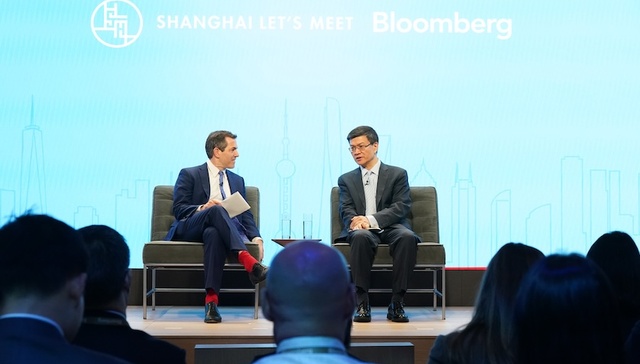
On June 30, the third-season launch ceremony and New York forum of Our Water: Flowing from Shanghai — Intercultural Dialogues among World Cities was held in New York. Representatives from politics, business, academia, culture and sport gathered for the event, with basketball star Yao Ming attending as an ambassador for Chinese sport.
Inside and outside the venue, the words "competition" and "cooperation" came up repeatedly. During the event, Bloomberg Economics chief economist Tom Orlik spoke with several media outlets, including Jiemian News, sharing his views on China-US economic and trade relations, the artificial intelligence race and the future direction of the global economy.
Orlik previously worked in Beijing for more than a decade. He has served as chief China economics correspondent for The Wall Street Journal in Beijing and chief Asia economist at Bloomberg. He has also worked at the UK Treasury, the European Commission and the International Monetary Fund. He is the author of The Bubble That Never Pops, which examines China's debt and property risks, and Understanding China's Economic Indicators.
China-US cooperation: finance offers room to work together
Asked where China and the United States have the greatest potential for cooperation, Orlik said that, speaking from New York, near Wall Street and at the center of US financial markets, finance was an area worth watching.
China's economy has taken on a "huge burden of debt" over the past few years, he said, and how to manage that debt and deleverage is now a major challenge. That is an area where people on Wall Street and experts in the US economy have relevant experience to share.
He also said there were many opportunities for exchange in business, academia, finance, culture and sport. Yao Ming's presence at the event, he added, was a reminder of how much China and the United States can do together when they focus on areas of cooperation.
China-US relations: a delicate balance
On the current state of China-US relations, Orlik said the two countries are in an "uneasy equilibrium."
The United States controls important parts of the semiconductor supply chain, which are crucial to China. China, meanwhile, controls important parts of the rare earth supply chain, which are important to the United States and the broader global manufacturing sector.
US power over semiconductors and Chinese power over rare earths, he said, have created an "uneasy stability" and an "uneasy equilibrium" between the two countries. The question, he added, is how long it can last, and what opportunities it may create for businesses and investors during this period of relative stability.
Orlik said differences between China and the United States are showing up in trade frictions, financial frictions and disagreements over geopolitical hot spots, creating challenges for businesses and investors.
But he said it was also important to remember that New York and Shanghai did not succeed because there were no challenges in the world. They succeeded, grew and made their populations more prosperous by recognizing challenges and adapting to them.
The Asian century: Asia as an engine of global growth
Orlik also discussed an article he wrote last year on the "Asian century."
He said that a few years ago, many economists projected China's growth trajectory forward and concluded that China would overtake the United States as the world's largest economy by the late 2020s or around 2030. But that easy consensus no longer exists.
China's growth has slowed as it deals with the correction in its property sector and a high debt burden, while a weaker yuan has also affected calculations of economic size. At the same time, the United States has begun to grow a little faster, partly because of developments in high technology and energy.
For many years to come, Orlik said, the United States will likely remain the world's largest economy and the world's biggest power. But China will not be "too far behind." That reality will create many opportunities for companies and investors, while also bringing risks of increased friction, as seen in tariffs, semiconductors and rare earths.
He said one of the defining developments now is the race for supremacy in artificial intelligence. AI is an exciting new technology, and who gets ahead in that race will be an important factor in determining who wins the global economic competition in the years ahead.
The AI race: several variables will decide the outcome
Asked how to define "victory" in the China-US AI race, Orlik laid out a multidimensional framework.
He said competitiveness in AI depends on several factors. The first is energy, because AI data centers consume enormous amounts of power, giving countries with abundant energy supplies an advantage. The second is hardware, especially the semiconductors networked together in those data centers. Countries with access to the technology needed to design and produce advanced semiconductors have an advantage in the AI race.
The third factor is the models themselves — who has the smartest model, whether it is US AI leaders or Chinese champions such as DeepSeek. The fourth is whether AI can be successfully deployed across the economy. Even the most sophisticated AI model will not be very useful if businesses cannot use it at scale to raise productivity. The fifth is public acceptance. If people worry that AI will take their jobs, then for AI to succeed and increase prosperity, they will have to want it and accept it.
China and the United States have different strengths, Orlik said. The United States is currently ahead in hardware, including the ability to design and make chips, and is slightly ahead in AI models. China, however, has deep energy resources and a strong capacity to put new technologies to work across the economy. Public opinion in China is also somewhat more favorable toward AI than in the United States.
"At the moment, the US has some advantages in some areas, and China has some advantages in others," he said.
A state-led development model can also deliver results
Asked whether Western economic models can still explain the structure of China's economy, Orlik said one challenge Western economists face is that China has a very different system.
In the United States and Europe, he said, economies are based more on free markets and private enterprise. In China, by contrast, the state plays a much larger role in the economy. Western economists often look at that and conclude that it must be a problem and a source of inefficiency.
But that analysis misses something important, he said. For an economy as large as China's, and one that is still catching up technologically, the state-led model can generate significant wins.
"I don't think the Western model is wrong or the Chinese model is wrong," Orlik said. "I think both of them have advantages for the economies in which they're operating."
China's economic outlook: old and new growth drivers coexist
Orlik's book on China argues that the country has taken on a huge debt burden and built substantial overcapacity in industry and real estate, creating risks for the economy.
Even amid the AI boom, he said, the risks described in his book remain visible. They can be seen in the contraction in fixed-asset investment, very weak consumption growth and weakness in housing prices.
But that is not the only thing happening in China's economy, he said. There is also strong excitement around AI entrepreneurs, including DeepSeek and other companies, as well as around electric vehicle manufacturers and their success in exporting Chinese cars around the world.
China's economy today is therefore moving along two tracks, he said. On one side is the old economy of heavy industry, real estate and infrastructure, which has played its role but is now losing strength and weighing on growth. On the other side is a new high-tech economy that is growing quickly.
When the two are put together, China's growth rate is "not terrible, but it's not amazing either," he said. Looking toward 2030 and beyond, however, Orlik said the new-economy drivers are likely to become the main story.
On the trend of Chinese companies going global, Orlik pointed to China's enormous scale. With a population of 1.4 billion, China can produce extremely efficiently, and that production efficiency can give rise to world-beating companies.
That, he said, is the story seen in China's metals sector and manufacturing sector, and he expects Chinese entrepreneurs to explore more such opportunities.
China and the US should focus more on domestic development than bilateral rivalry
On the next stage of China-US relations, Orlik offered a somewhat counterintuitive view: China-US relations are important, but both countries should pay more attention to their domestic markets and internal dynamics.
Getting the trade relationship, financial relationship and diplomatic relationship right would be good for both sides, he said. At the same time, the United States and China are both vast, continent-sized economies, and most of what they do happens at home.
Trade is important for both China and the United States, he said, but it is not as important as domestic investment and consumption.
In his view, Beijing and Washington should think about what more can be done at home to drive growth, including investment in capital stock, infrastructure, people and education. That, he said, will ultimately be the more important driver of prosperity.
"If the US and China are doing well at home, I think that’s gonna make it easier for them to get on with each other as well," Orlik said.
Orlik, who lived in Shanghai for a couple of years and later in Beijing for several years, said direct people-to-people exchanges are important for mutual understanding. Both sides, he said, still have more work to do to make such exchanges easier and more welcoming.