

by JIA Lu
Editor's note: To provide more timely, comprehensive and accurate insights into China's electric passenger vehicle exports, Jiemian Intelligence and SINOIMEX jointly launched the China Electric Passenger Vehicle Export Monthly Report in March 2025. The report tracks monthly changes in export value, export volume and destination markets, providing reference for governments, companies and investors.
China's electric passenger vehicle exports began 2026 on a strong note, according to data compiled by Jiemian Intelligence and SINOIMEX. In the first two months of the year, total trade reached US$14.86 billion, up 93.01 per cent from a year earlier. Export value rose 94.40 per cent to US$14.40 billion, while export volume climbed 86.11 per cent to 758,000 units, signalling a robust start even from an already elevated base.
Seasonal softness, sustained export momentum
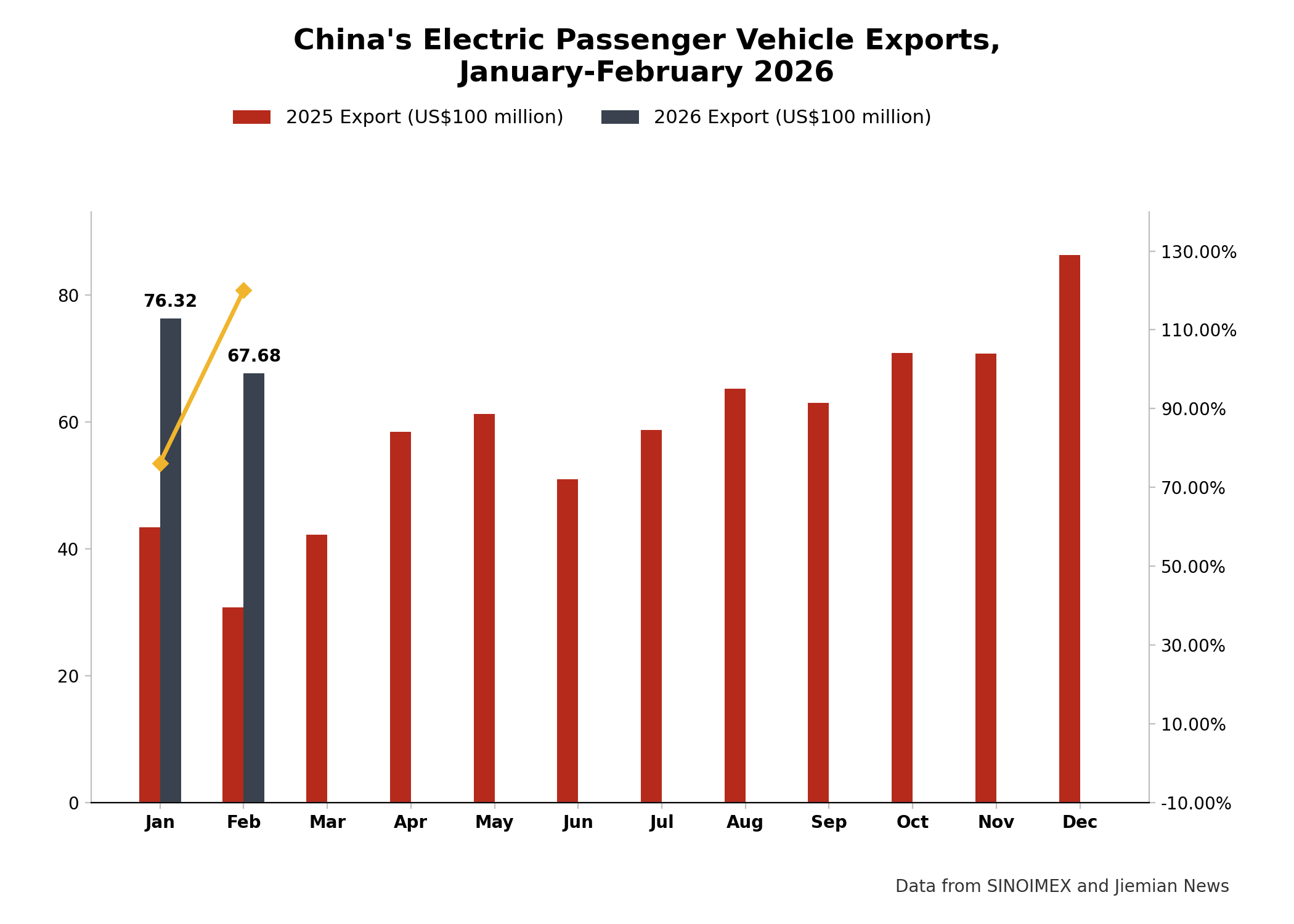
Monthly data show some seasonal softness in February but stronger year-on-year momentum. Export value totalled US$7.63 billion in January and US$6.77 billion in February. February export value was down 11.32 per cent from January, likely reflecting holiday-related disruptions, but up 120.00 per cent from a year earlier. Export volume in February reached 371,100 units, down 4.07 per cent month on month but up 119.60 per cent year on year. The average export price was US$18,237.38, down 7.56 per cent from January but up 0.19 per cent from a year earlier, pointing to broadly stable pricing.
Passenger vehicles continued to dominate the export structure. In January-February, they accounted for 99.63 per cent of export volume and 95.25 per cent of export value, with cumulative export value reaching US$13.74 billion, up 95.49 per cent from a year earlier. Battery-electric passenger vehicles remained the largest segment, with an average export price of US$17,179.53, up 4.19 per cent year on year. Plug-in hybrids and non-plug-in hybrids also posted higher shipment volumes without significant erosion in export prices, suggesting a healthier balance between scale and pricing than in some of the late-2025 months.
Bus exports also contributed to the upbeat start. Total bus export volume in the first two months reached 2,661 units, up 41.17 per cent year on year, while export value rose 73.89 per cent to US$658 million. Average prices for battery-electric buses climbed 22.92 per cent to US$247,176.01, and hybrid buses rose 101.72 per cent to US$232,729.29, indicating a clear move toward higher-value product structures in the bus segment.
Shanghai, Anhui and Zhejiang lead the new-year ranking
Shanghai was the leading EV export source region in the first two months of 2026, with export value of US$3.78 billion, up 118.21 per cent from a year earlier. Anhui ranked second with US$2.09 billion, surging 317.31 per cent, while Zhejiang came third at US$1.62 billion, up 117.90 per cent. The top 10 source regions together accounted for 86.12 per cent of total export value, showing that the sector remains highly concentrated geographically.
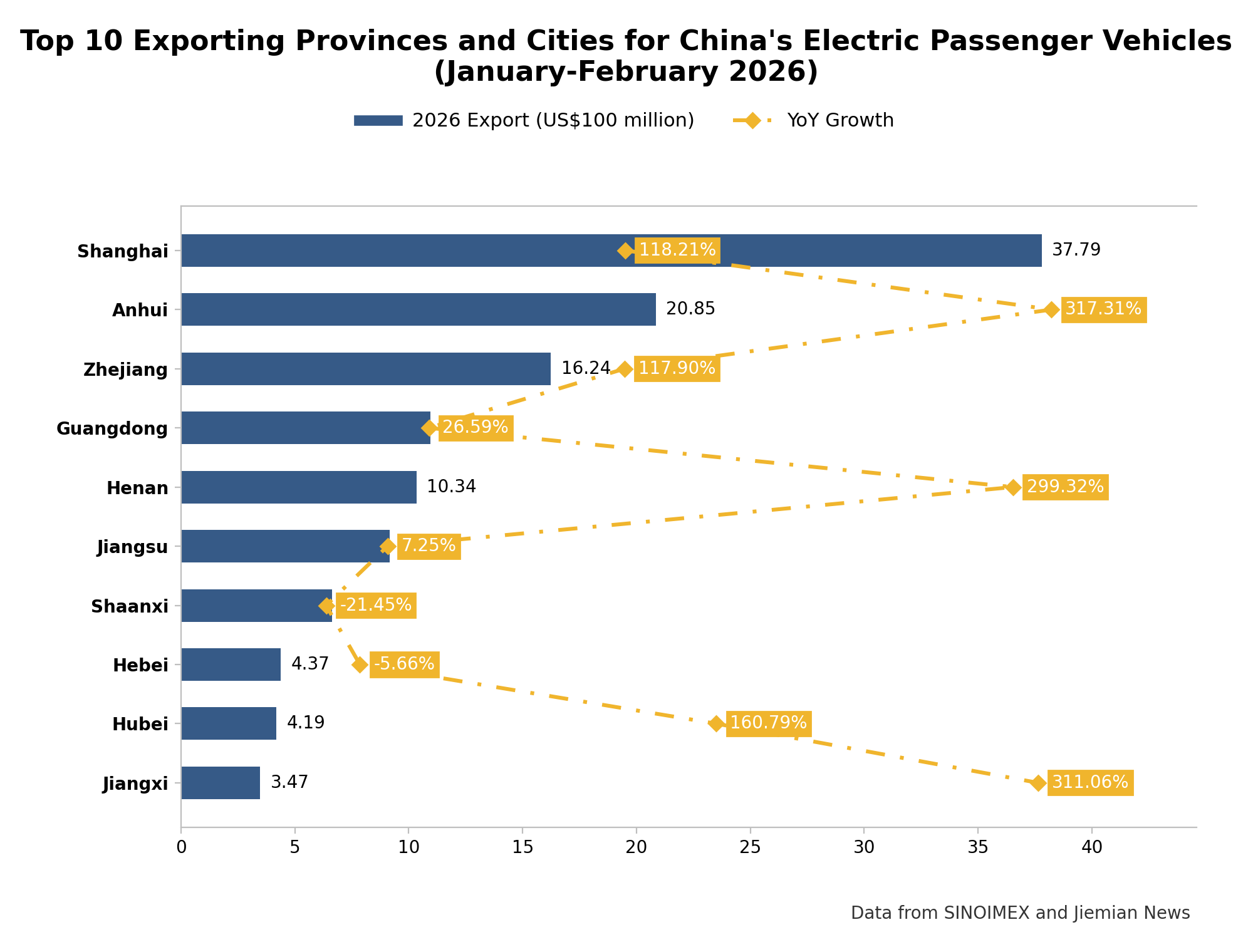
Growth was widely distributed but still uneven. Ningxia, Guizhou, Gansu, Guangxi and Anhui recorded the fastest year-on-year increases, while Hainan, Jilin, Tibet, Shaanxi and Heilongjiang ranked among the weakest performers. Overall, 24 provincial-level regions posted export growth, and 17 of them saw gains above 100 per cent, suggesting that the export boom is broadening while still favouring stronger manufacturing bases.
Europe remains the largest market while Africa surges
The UK was China's biggest EV export destination by value in January-February at US$1.40 billion, up 113.30 per cent from a year earlier. Belgium ranked second with US$1.30 billion, up 31.13 per cent, and the UAE placed third with US$1.17 billion, up 127.91 per cent. The top 10 destinations together accounted for 58.98 per cent of total export value.
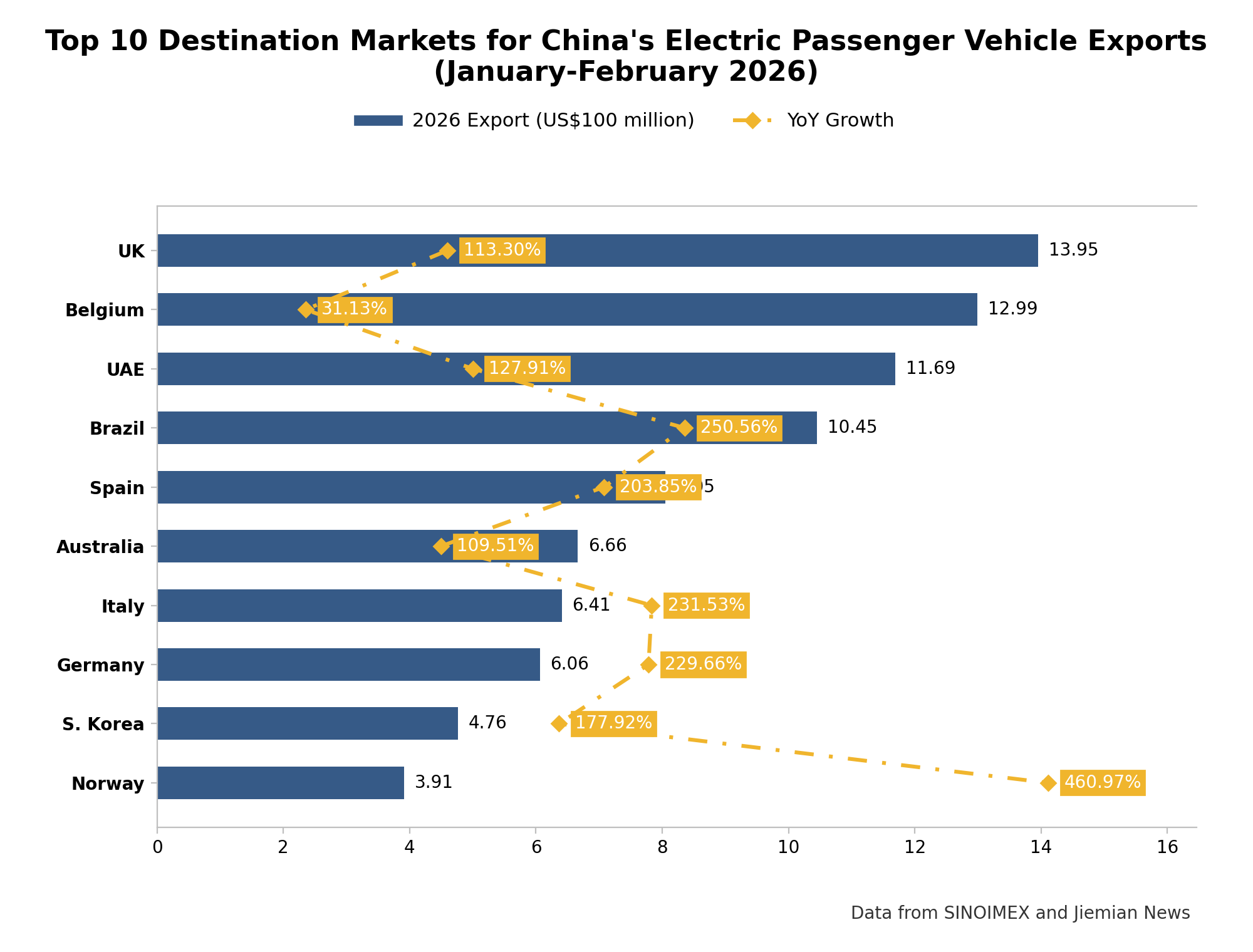
Compared with the same period a year earlier, Italy, Germany, South Korea and Norway entered the top-10 destination list, while Mexico, Israel, Slovenia and Thailand dropped out. That reshuffling points to a changing overseas demand map in which Europe is becoming even more central to China's EV export strategy.
Some of the fastest-growing destinations were much smaller markets. Sri Lanka, Yemen, the Democratic Republic of the Congo, Libya and Slovakia recorded the highest year-on-year growth in export value. China posted export gains to 137 countries and regions while exports to 28 markets declined, highlighting the breadth of the current upcycle.
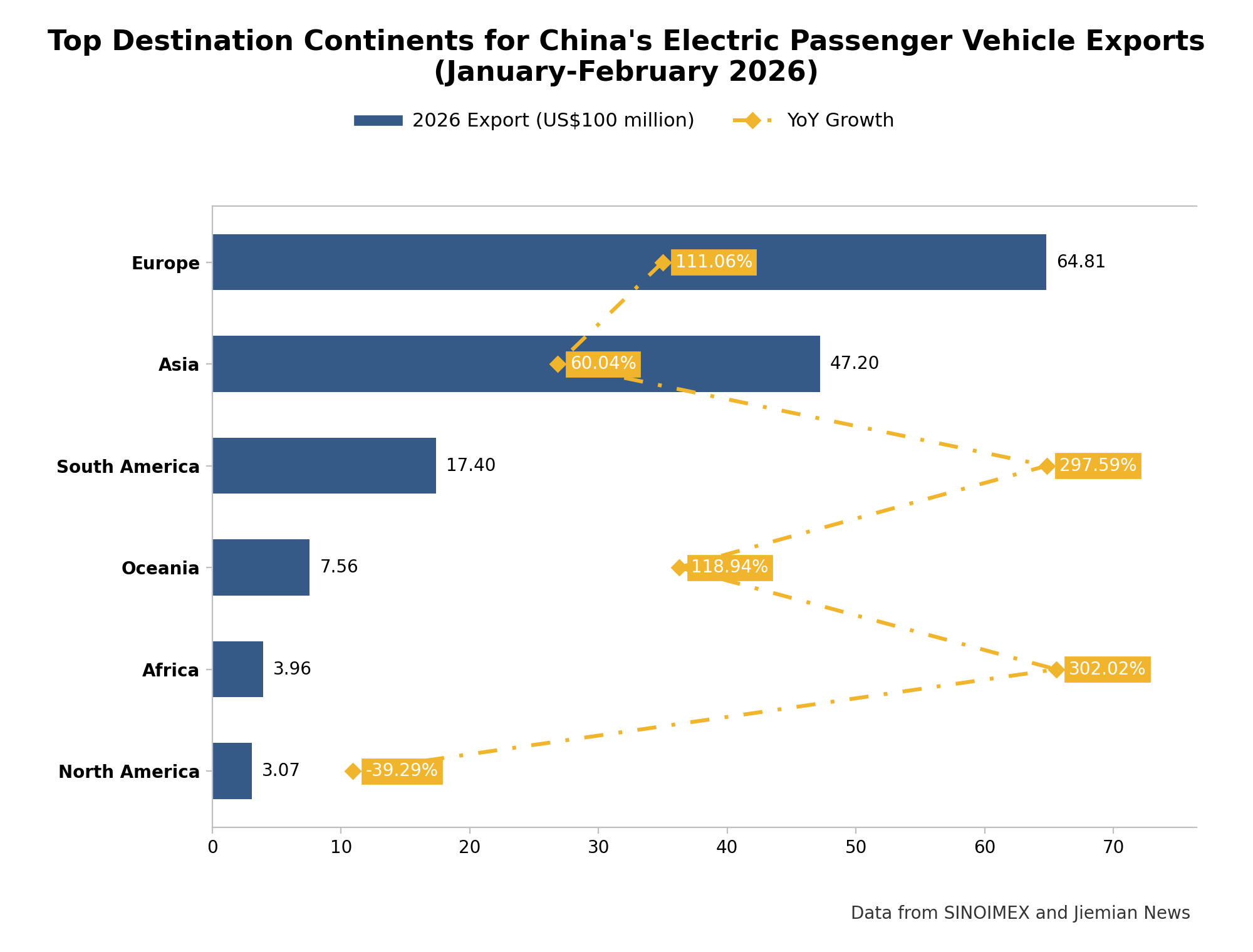
By continent, Europe remained the largest export market in the first two months, with trade value of US$6.48 billion, up 111.06 per cent from a year earlier. Africa stood out as the fastest-growing region, however, with exports to 50 African countries and regions rising 302.02 per cent to US$396 million. The combination of strong European demand and rapid African expansion suggests that China's EV exporters are gaining traction at both the high-volume core and the emerging frontier of global markets.
Trade policy shifts and localisation plans push carmakers further outward
The opening months of 2026 also brought a more complex policy environment for the global EV industry. China and the EU made progress in discussions related to the EV case, agreeing on general guidance for price undertakings by Chinese exporters, with the European side saying it would assess applications on a non-discriminatory and objective basis. India, by contrast, saw its electric passenger car manufacturing incentive programme stall, with no automakers submitting applications before the online platform closed.
The UK introduced a GBP318 million subsidy programme for electric truck purchases, while Canada announced during its prime minister's visit to China that it would cut tariffs on Chinese EV imports from 100 per cent to 6.1 per cent under a quota mechanism that starts at 49,000 vehicles and rises gradually. Canada later also relaunched EV purchase subsidies and signalled interest in cooperation with China on local production and exports.
Domestic policy adjustments in China added another layer to the outlook. The Ministry of Finance and the State Taxation Administration said export VAT rebates for products including solar goods would be cancelled from April 1, 2026, while rebates for battery exports would be reduced in stages and removed entirely from 2027. Regulators also issued new guidance on cross-border automotive data security and pricing compliance, adding clearer guardrails for the industry's next phase of development.
Against that backdrop, Chinese automakers are speeding up overseas localisation and global capability-building. Xpeng plans to establish local supply-chain teams in Europe and ASEAN. BYD is advancing local parts manufacturing in Brazil while studying the feasibility of a Canadian plant. SAIC, Chery, Geely, Nio and Leapmotor are all expanding their footprint across Europe, ASEAN, South America and the Middle East.
In intelligent driving, Baidu's Apollo Go has launched fully driverless commercial operations in Abu Dhabi and secured Dubai's first full-driverless testing permit, while Qianli Technology and Geely used CES 2026 to launch the G-ASD assisted-driving brand for global markets. Together, these developments show that China's EV exporters are no longer relying solely on product shipments, but are increasingly pairing manufacturing, technology and compliance capabilities in overseas expansion.
The early 2026 picture points to a more mature phase of China's EV export expansion. Shipments remain strong, product structure is improving and overseas strategies are becoming more localised, policy-aware and technology-driven. Rather than simply chasing volume, Chinese automakers are increasingly building the long-term global systems needed to sustain growth.