

by JIANG Xi
After flying nearly 9,000km from Istanbul, a Turkish buyer walked into a Shanghai exhibition hall with a single goal: to source Chinese machine tools.
"I came for Chinese equipment," said the procurement executive at a valve manufacturer, moving quickly through the halls of the China CNC Machine Tool Fair (CCMT2026).
Held from April 21–25, the exhibition brought together more than 2,000 companies from 27 countries and regions, making it Asia's largest machine tool event this year — and a window into how global demand is tilting toward China. Shanghai reflects that shift, with a dense cluster of state-owned manufacturers, specialized private firms and foreign brands operating side by side.
The Turkish buyer skipped most stands, stopping only at those that caught his interest. He compared products directly with established global brands, collected digital catalogues and photographed booths to track potential suppliers.
"Too many contacts during the show — photos help me remember," he said.
Despite limited Chinese-language materials, he relied on instinct. "The bigger the booth, the bigger the company — and usually the better the quality."
Nearby, a Russian buyer from a specialized equipment firm described a similar shift. Fresh from a factory visit in Weihai, he had come straight to Shanghai.
"Every year it gets bigger — more exhibitors, more new players," he said. This was his third trip to China this year. He said his next trip could be to sign orders.
Both buyers pointed to the same conclusion: Chinese machine tools are advancing rapidly.
"Prices are lower, but the technology gap is closing rapidly," the Russian buyer said. “They’re becoming competitive.”
For many overseas customers, price remains the entry point. But improving performance is increasingly securing repeat orders.
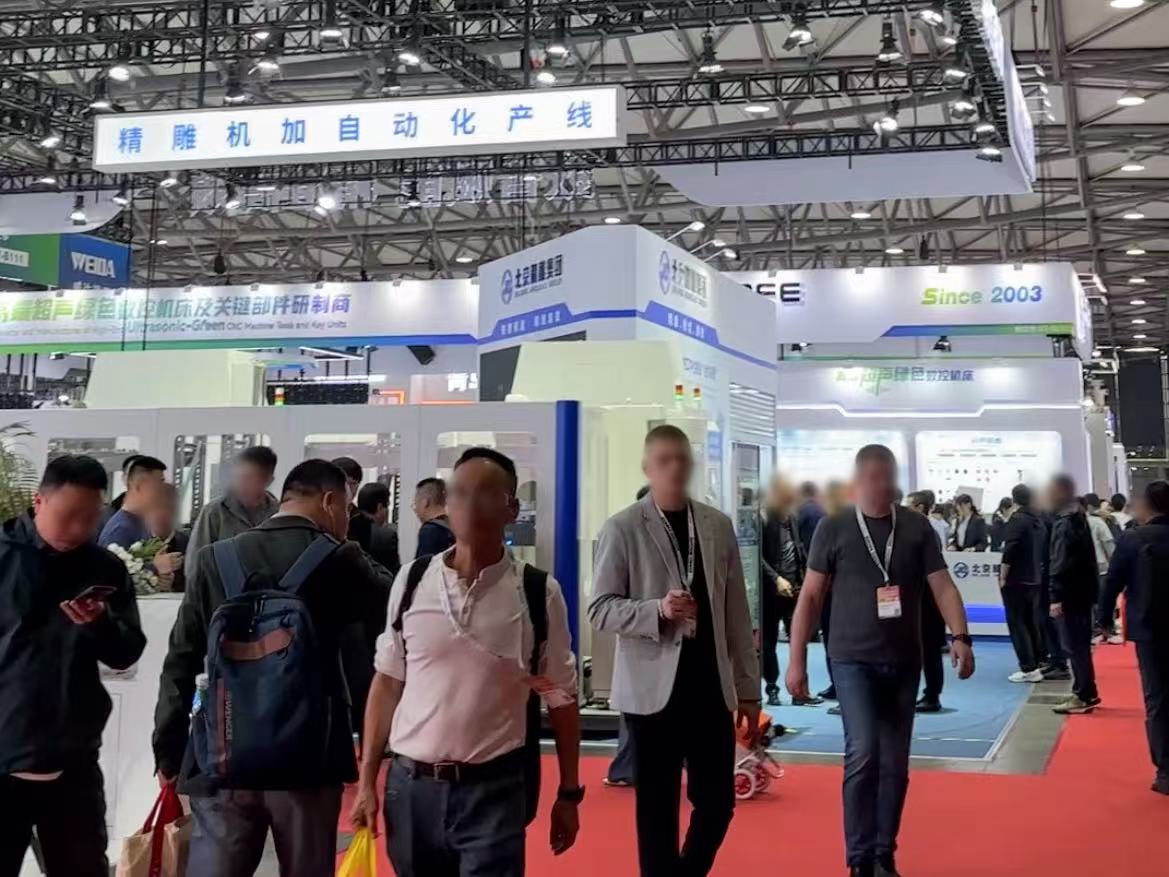
China now accounts for about 32% of global machine tool output, ahead of Germany (18%) and Japan (16%), according to the China Machine Tool & Tool Builders' Association. Its export share reached 21.6% in 2025, overtaking Germany’s 16.7% for the first time, industry data cited by local media showed. Shanghai, the host city, reflects that scale, with a dense cluster of state-owned manufacturers, specialized private firms and foreign brands operating side by side.
"This is serious competition for European manufacturers," said a German component supplier at the exhibition, pointing to China’s lower costs and faster delivery cycles.
He estimated that Chinese machines can now meet around 90% of market demand, a sharp improvement from a decade ago.
Some buyers believe the shift is only beginning. The Turkish executive predicted that Chinese machine tools could take a dominant position in Europe within five years.
Chinese manufacturers are accelerating their overseas push. Genesis (300083.SZ) said overseas revenue rose 88.26% to 391 million yuan in 2025, while Qinchuan Machine Tool (000837.SZ) and Haitian Precision (601882.SH) also reported strong export growth.
Overall, China's machine tool exports reached US$23.18 billion in 2025, up 6.7%, with metal-cutting machines rising 11.5% to US$6.25 billion.
Yet the industry's ascent remains uneven — particularly in high-precision finishing, where European, Japanese and US players still control about 70% of the global high-end market.
Domestic users see the same gap. Engineers at an auto parts supplier in Hubei said Chinese machines can handle most daily production, but key equipment still relies on imported brands to ensure stability and precision.
Beyond technology, overseas buyers point to more immediate constraints.
After-sales service is the biggest concern. "When I buy from China, I want to know if support is available," the Turkish buyer said, adding that many suppliers priorities sales over after-sales support.
Distribution gaps add to the friction. In markets such as Turkey, the lack of local dealers means buyers often have to travel to China directly.
Language remains a barrier. "If more companies communicated in English, they could sell in more markets," he added.
Executives say the industry is shifting from scale to technology and value creation, supported by demand from sectors such as aerospace, new energy and humanoid robotics.
China's next five-year plan also prioritizes breakthroughs in core technologies such as machine tools, signaling stronger policy backing.
"The industry is entering a new phase of growth," said ZHOU Zhou, chief engineer at General Technology Group, citing the convergence of policy, market demand and technological progress.