

by LIANG Baoxin, ZHANG Xilong
A Chinese superbike built on a tightly integrated supply chain in Jiangmen has drawn global attention after a breakthrough racing victory — underscoring how regional manufacturing clusters are reshaping the industry.
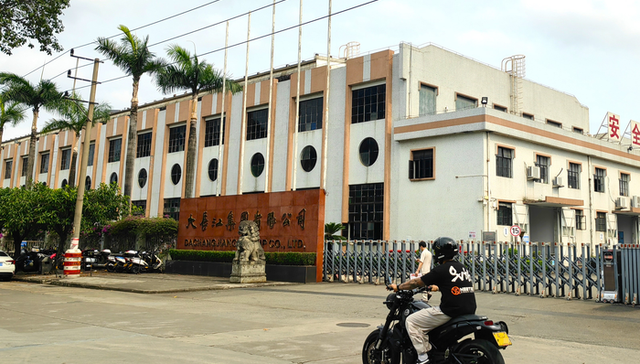
Driving north from Jiangmen railway station, blue road signs reading "Motorcycles Keep Right" appear at intervals. Steel-structure factories replace street-side shops, marked with signs for "engine assembly", "precision casting" and "vehicle assembly".
Within a few kilometres, the entire production cycle comes into view — from casting engine cylinders to testing high-performance bikes on the road — offering a snapshot of one of China's most comprehensive motorcycle supply chains.
That ecosystem has drawn global attention following a championship win by a bike developed by Chinese racer ZHANG Xue, with key components — including the helmet, exhaust system and engine cylinder — all produced in Jiangmen.
Today, about one in every five motorcycles China exports comes from the city. In 2025, three Jiangmen-based manufacturers — Dachangjiang Group, Tayo Motorcycle and JMZF Motor — were among China's leading motorcycle makers by sales.
Origins and industrial rise
Unlike Chongqing, another major motorcycle hub rooted in military manufacturing, Jiangmen's industry grew out of overseas trade in the 1980s. A large share of imported motorcycles once passed through the city, exposing local traders to foreign brands and pushing them up the value chain from distribution to parts and eventually full-vehicle production.
Dachangjiang Group became a defining case. Founded in 1992, it partnered with Japan's Suzuki Motor, introducing mature models such as the AX100 and GN125 and adapting them to local fuel standards and road conditions. By doing so, it scaled rapidly, surpassing 1 million units in annual output by 2003.
As a leading local player, Dachangjiang fostered a network of suppliers. Former employees spun off component factories, while small workshops scaled up with demand. "Many smaller suppliers rely on the scale of large manufacturers to grow," one industry participant told Jiemian News.
A supply chain built for scale and speed
Over decades, Jiangmen has built a vertically integrated supply chain, from basic components to high-performance parts.
"The industry here is very complete — you can source almost every part locally," said ZHANG Hongming, a planning executive at JMZF Motor. "If I were Zhang Xue, I could assemble a bike in a single day in Jiangmen."
That capability is driven by tight local control over core technologies and a specialized supplier base. Helmet maker LS2 has obtained FIM certification, while local firms such as Ruiyue and Chaoyang Precision focus on performance components and materials engineering, including ceramic coatings that improve durability and heat dissipation.
Hundreds of smaller firms specialize in individual components, forming a modular network that enables rapid prototyping and iteration. In some cases, suppliers also share development risks, helping shorten product cycles.
Jiangmen's role extends beyond its own production base. The shift is part of a broader trend in China's manufacturing sector, where regional clusters are moving up the value chain from low-cost production to higher-end engineering and integration.
The industry is often seen as divided into three main clusters: Chongqing, Zhejiang and Jiangmen. Chongqing dominates large-scale manufacturing, while Zhejiang leads in branding and capital operations.
Jiangmen, by contrast, centers on engineering capabilities and key components, supplying parts and technical support to manufacturers across regions.
Some local suppliers work more closely with clients in Chongqing than with nearby assemblers. Others have entered supply chains of Zhejiang-based brands such as CFMOTO.
Jiangmen's technological footprint is now embedded across China's motorcycle production system, regardless of where final assembly takes place.
Limits of scale — and what comes next
Despite its supply chain strength, Jiangmen faces structural challenges.
Domestic demand is weakening, as electric vehicles, ride-hailing and public transport erode traditional use cases. Motorcycles are shifting from necessity to discretionary purchase.
Price competition is also intensifying. Entry-level commuter motorcycles now sell for as little as 2,000–3,000 yuan, with profit margins that can fall to around 100 yuan per unit.
At the higher end, local manufacturers have remained cautious. Large companies such as Dachangjiang have long prioritized reliability and scale over branding and performance segments, limiting their presence in premium motorcycles.
"This has been technically possible for years, but it hasn’t made commercial sense," one industry insider said.
The rise of higher-displacement motorcycles signals a shift in demand, particularly among younger consumers seeking lifestyle and performance products rather than basic transport.
Local companies are beginning to respond. Zhufeng has launched large-engine projects, while Dachangjiang is expanding into 400cc and 500cc models.
At the same time, Jiangmen is investing in infrastructure to support this transition. In 2025, the city opened Guangdong's first public motorcycle testing facility, integrating R&D, testing and validation functions.
Authorities are also promoting cultural branding, aiming to link the motorcycle industry with tourism and lifestyle experiences.
Yet challenges remain. Urban infrastructure is still geared toward traditional transport, with limited dedicated motorcycle lanes. Social perceptions — often associating motorcycles with noise and safety risks — also constrain broader adoption.
For industry participants, Zhang Xue's victory is both a milestone and a warning.
It highlights the strength of China's manufacturing ecosystem — and Jiangmen's role within it — while also underscoring the limits of relying on supply chains alone.
As global competition shifts from cost and production to branding and consumer experience, the next stage of growth may depend less on how motorcycles are made, and more on how they are positioned.
The challenge now is whether Jiangmen can move beyond being a manufacturing hub — and turn its industrial strength into brands that resonate globally.