

by WU Yangyu
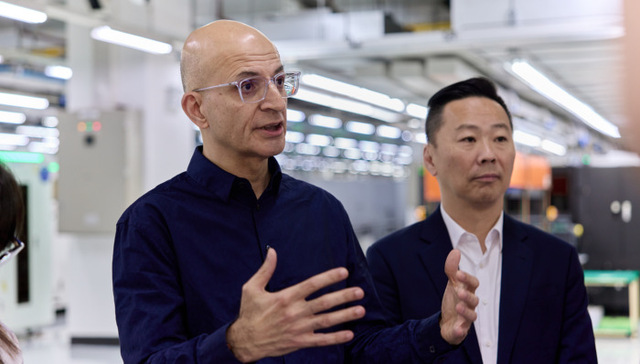
Apple Chief Operating Officer Sabih Khan's March 17 tour of Shenzhen and Chengdu highlights China's continued role in the company's global manufacturing network, even as Apple steps up diversification efforts.
He visited facilities run by Sunwoda Electronic Co., Ltd. and Foxconn Technology Group, key suppliers that anchor Apple's manufacturing network, spanning component production and final assembly.
The trip came less than six months after Apple executives last visited China, at a time when the company is expanding production in markets such as India and Vietnam but still relies on China for core manufacturing capabilities.
Sunwoda, which has supplied Apple for more than 20 years, provides components for devices including the iPhone, iPad, Mac, Apple Watch and AirPods. Foxconn remains the primary assembler of the iPhone and supports a broader range of Apple products.
At Sunwoda's plant, production lines have adopted magnetic levitation systems, replacing traditional conveyor belts. The system has undergone multiple upgrades over the past decade, moving from manual operations to automation and, more recently, to six-dimensional magnetic levitation for more flexible production configurations.
These systems can adapt to different battery sizes and shapes, cutting setup time from two hours to six minutes, a reduction of about 95%, according to the company.
Digital twin systems are used for real-time monitoring and remote diagnostics, with engineers accessing data through Apple Vision Pro. The technology has reduced fault response times by 72%, according to the company.
For quality control, Sunwoda and Apple have developed an automated inspection system that uses iPhones for on-device analysis.
Khan later visited Foxconn's Guanlan facility in Shenzhen, where he toured motherboard production and final assembly lines, including a "lights-out" factory where operations run without human intervention.
Processes from material handling to logistics are centrally coordinated using digital twin systems.
In Chengdu, Foxconn operates a newly launched assembly line for a recently introduced MacBook model, using automated screw-fitting technology to simplify production and remove the need for rivets. The site, which began assembling iPad products in 2010, now also produces MacBook, Apple Watch, displays and casings.
Khan described Apple's relationship with suppliers as "symbiotic" and said priorities in China's latest Five-Year Plan — including advanced manufacturing, talent and "AI+" — can be seen in current production practices.
As automation advances, questions remain about labor's role. Khan said Apple will continue investing in training programs in AI, coding and leadership, with new "AI+" courses planned with suppliers in 2026.
Foxconn executive JIANG Jiheng said China remains the group's primary base for engineering validation and manufacturing, citing factors including its talent pool and supply chain ecosystem.
"Any innovative concept can be quickly turned into a mass-producible product in China," he told Jiemian News.
Sunwoda said it has achieved 100% renewable energy use in Apple-related production and built a battery recycling system. Foxconn's China facilities have likewise reached 100% renewable energy usage and joined zero-waste-to-landfill programs.
Apple said its China-based suppliers saved about 55 billion liters of freshwater over the past year through clean water initiatives.