

by ZHOU Shuqi
When German Chancellor Friedrich Merz left China after a two-day visit, a familiar script in Sino-German automotive relations appeared to be fading.
For decades, the formula was straightforward: Germany supplied engineering and premium brands; China supplied scale and growth. That balance is now shifting as China consolidates advantages in batteries, software development and supply-chain efficiency, forcing German carmakers to rethink their role in the world's largest auto market.
Merz's first trip to China since taking office was accompanied by 30 German business leaders, the largest economic delegation since the early years of Angela Merkel's tenure. Among them were Oliver Blume of Volkswagen Group, Oliver Zipse of BMW Group and Ola Källenius of Mercedes-Benz Group.
The show of corporate weight reflected the stakes. Germany's auto industry has shed more than 50,000 jobs over the past year as demand slows and restructuring accelerates. Meanwhile, China accounts for roughly one-third of global sales for the country's three premium brands.
Yet their position in China has weakened. Data from the China Passenger Car Association show German marques sold 3.645 million vehicles in 2025, down nearly 10% year on year. Mercedes-Benz, BMW and Audi together delivered about 260,000 fewer cars than in the previous year.
Chinese technology moves into premium lines
One of the most symbolic moments of the visit came at Mercedes-Benz's Beijing plant, where Merz test-rode a new S-Class fitted with an assisted-driving system developed by Momenta, a Beijing-based autonomous driving technology company. People present said he described the system as impressive.
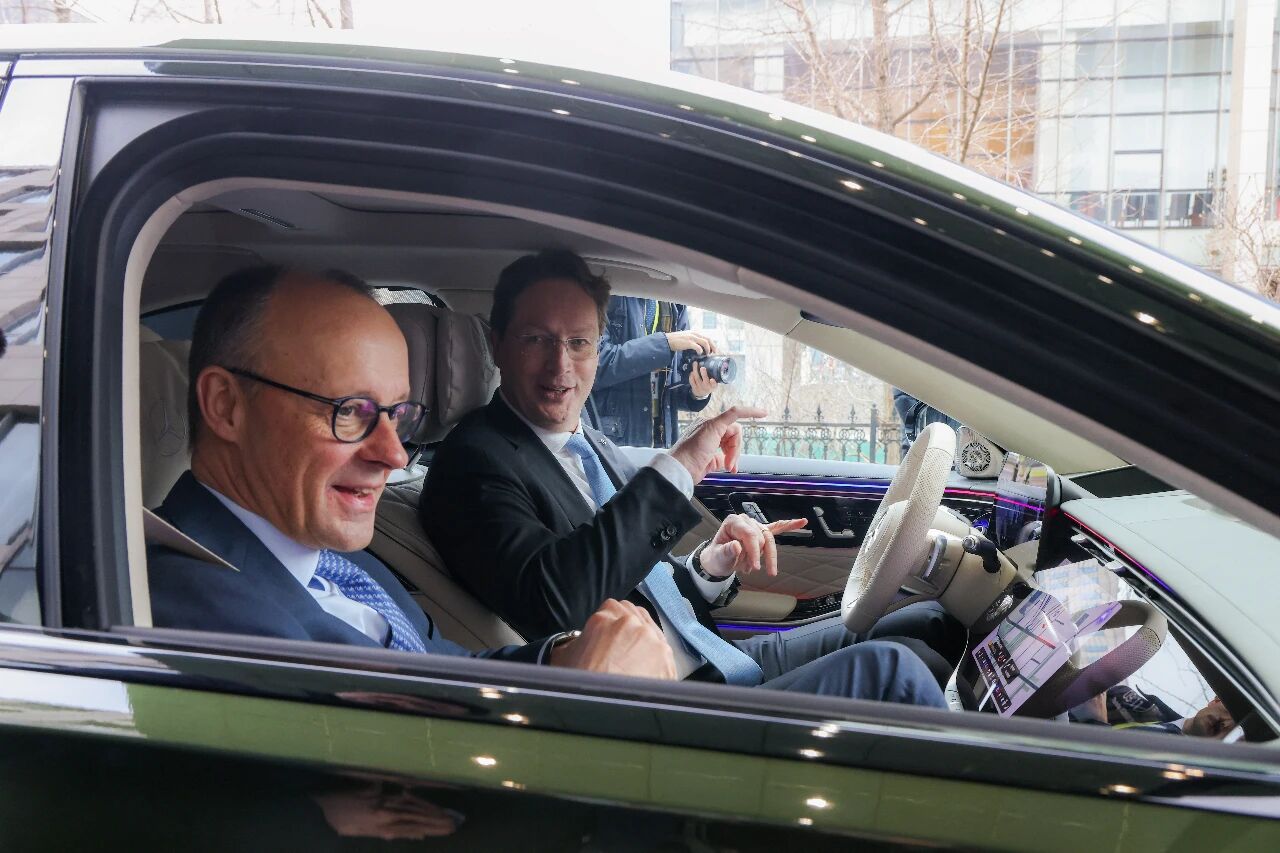
On the same day, Mercedes-Benz signed an upgraded memorandum of understanding with Momenta to deepen cooperation in intelligent driving. The jointly developed system is set to be deployed in nine new Mercedes models due to launch in 2026, covering multiple segments.
The episode highlighted a broader shift: Chinese technology providers are no longer confined to cost-sensitive segments but are being integrated into the core product lines of established European luxury brands.
BMW Group also signaled closer ties with CATL, China's largest electric vehicle battery maker, announcing cooperation on battery passport data pilots and supply-chain carbon footprint reduction.
With carbon accounting becoming a prerequisite for entry into the European market, the partnership reflects not just corporate compliance but an effort to align Chinese and German players within an evolving global regulatory framework for electric vehicles. Zipse said sustainability was increasingly the common ground in China-Europe relations and that industrial transformation required closer global coordination.
From market access to capability shift
Stephen Dyer of global consulting firm AlixPartners told Jiemian News that collaboration between Chinese and German automakers would likely intensify.
He said Chinese carmakers had once learned systematically from German companies, from product development to supply-chain management, but that the dynamic had since reversed, with German manufacturers now looking to Chinese firms for expertise in building software-defined vehicles.
China's faster development cycles and consumer electronics-style iteration have exposed the limits of the traditional five-year automotive product timeline. What was once a profit engine for German brands is increasingly becoming a proving ground for technological competitiveness.
Paul Gong, head of China autos research at UBS, described China as a "fitness center" for multinational carmakers seeking to sharpen their edge. With a deep pool of engineers, a mature battery supply chain and rapid advances in autonomous driving, integrating China more fully into global R&D structures will be decisive over the next decade, he said.
German manufacturers have already begun to adapt. Volkswagen is investing heavily in localized electric platforms and software systems. Mercedes-Benz has expanded local research and development and invested 1.34 billion yuan in an intelligent driving company under Geely. BMW has built battery capacity in Shenyang and established multiple R&D and software centers across China.
These moves suggest the long-standing "technology for market" bargain is giving way to something more complex: a restructuring of capabilities in which Chinese partners play a central role in defining next-generation products.
Merz's visit is unlikely to alter trade figures in the short term. But it underscored a deeper reality. In the era of electrification and intelligent mobility, China is no longer simply a destination market for German automakers. It is becoming a source of the technology they increasingly depend on.