


by ZHANG Yi
Mingyang Smart Energy Co (601615.SH), one of China's leading offshore wind turbine makers, plans its largest-ever overseas investment — a £1.5 billion (about USD$2 billion) integrated manufacturing base in Scotland, which would also be the UK's first full wind power supply-chain hub.
The project marks a turning point for Mingyang, whose overseas revenue makes up only 2% of its total. The Guangdong-based company said the new base will produce offshore and floating wind turbines to serve markets in Britain, Europe and beyond, accelerating its push to become a global wind power player. "This follows our long-term strategy to localize operations and expand global capacity," a company spokesperson told Jiemian News.
Mingyang's expansion comes as the global offshore wind market enters a new growth phase. The Global Wind Energy Council (GWEC) projects annual new installations to rise from 117 GW in 2023 to 182 GW by 2028, with offshore additions expected to surge from 11 GW to 37 GW over the same period. The UK, one of Europe's largest wind markets, aims to quadruple offshore installations by 2030 under its Clean Energy Industries Sector Plan released in July.
Mingyang said the Scottish project will begin with nacelle and blade production by 2028, gradually expanding into floating turbine and component manufacturing, with funding from internal resources, proceeds of its 2022 GDR issue, and future bank loans.
While the company's cash position appears solid — with 13.7 billion yuan in cash and marketable assets as of mid-2025 — its debt has risen sharply. Short-term loans surged from 260 million yuan in 2022 to 3.9 billion yuan, while long-term debt more than doubled to 13.4 billion yuan, pushing its liability ratio close to 70%. Operating cash flow has remained negative for three consecutive years.
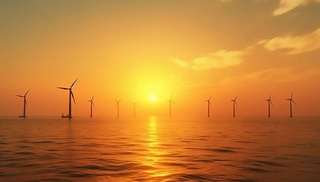
Mingyang said the new plant will showcase its floating wind technology, designed for deepwater zones where conventional turbines are impractical. The company launched one of the world's largest floating turbine models last year and is running demonstration projects in China. Floating wind farms, though costly — about three times the unit cost of fixed-bottom projects — are seen as the next frontier as nearshore resources reach saturation.
The firm said it has held talks with the UK and Scottish governments, as well as Britain's sovereign wealth and export credit agencies, but regulatory approvals are still pending. Analysts say the project could face political and operational risks, including high upfront costs and geopolitical uncertainty.
Mingyang's aggressive overseas push reflects the fierce price competition in China's wind sector, where margins have eroded for years. Its gross margin dropped from 21.4% in 2021 to 8.1% in 2024, though it recovered to 12.1% in the first half of 2025.
Mingyang's shares have climbed about 50% since midyear, lifting its market value to 39.1 billion yuan. Analysts say the gain partly reflects investor optimism about an industry recovery and confidence in the company's overseas expansion strategy.